Living through history. Our changing food environments. 1980s – 2010s.

Ultra-processed food (2)

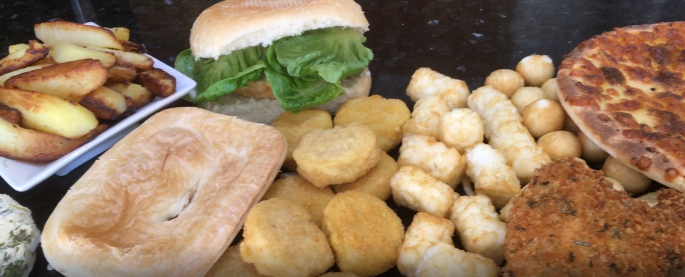
Within two generations there has been a complete restructure of our food environments from mainly fresh foods prepared in the home, eaten with family or friends at the table with plates and utensils; to a high proportion of fast food, convenience food, snack-food, confectionery; from or at restaurants, cafes, take-away outlets and food-halls; out of bags, packets, bottles, cans, tubes, tubs … and eaten on the run. Continue reading “Living through history. Our changing food environments. 1980s – 2010s.”

Living through history. Our changing food environments. 1950s – 1970s.


fridge (2)

While I was growing up and in the years as a young adult, as my own family mainly consumed home-prepared foods, garden-grown vegetables and eggs from our back-yard hens; swirling all around me were economic improvements and major shifts in social norms, a prelude to the storm that was to become a complete restructure of our food environments within a generation.

Working and walking

In my parents youth, in the 1930s and 1940s, times were tough with the depression, World War 2, and food rationing. The 1950s through to the 1970s were decades of relative improved prosperity. My father worked full-time. Initially he rode a bicycle to work. In the 1950s only 10% of families had cars. (2) Gradually we became a one-car and in the 1960s a two-car family. My mother was a homemaker, as the majority of women were in the 1950s. There were no modern appliances. Housework took many hours with washing, ironing, sweeping, cleaning, and chopping wood. The evening meal was cooked over many hours. In the 1950s, women averaged 77 hours per week housework. (2) As children we walked to and from school, except on rainy days when we caught the bus. After school we rode bikes around the neighbourhood or played in the back yard. Continue reading “Living through history. Our changing food environments. 1950s – 1970s.”

Food. What’s in it?

.

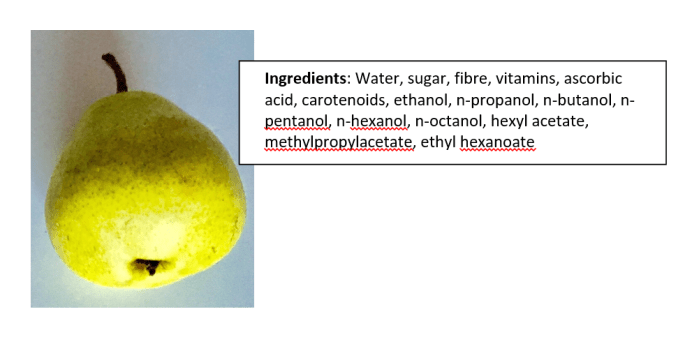
Pear.ingredients.
Pear Ingredients (1-5). Photo by Leonie Elizabeth. January 2018

FOOD –  WHAT’S IN IT?

Food is comprised of many distinct chemical substances which can broadly be divided into nutritional and non-nutritional components.(6-8)

Nutritional components

Nutrients are chemical substances in the food we eat that interact within the body and are needed throughout the whole of life. There are six main types of nutrients in foods, divided into 2 main groups. Continue reading “Food. What’s in it?”

Good foods, bad foods


Photo 2-3-18, 12 28 11 pm
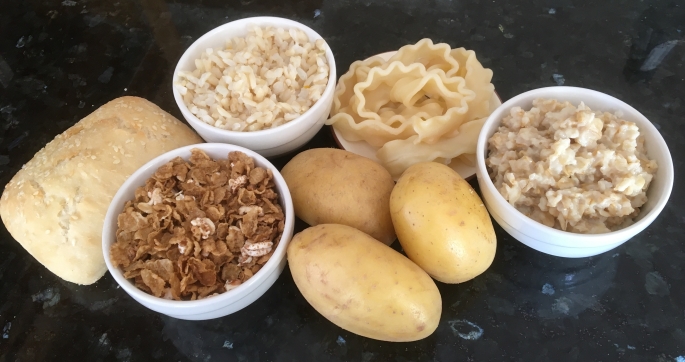
Bread, rice, pasta, oats, potatoes, wheat /oats cereal. Photo by Leonie Elizabeth 01 March 2018.


Good food, bad foods

When my eldest son was about seven years old, he came to me distressed about a school project on food. He had learned from his teacher that brightly coloured vegetables and fruit were good foods. He had also learned fatty snacks such as crisps, and confectionery were bad foods. His distress was that he didn’t know how to classify many of the foods our family were eating. He wanted to know whether we ate good or bad foods.

There was a background to his question. Continue reading “Good foods, bad foods”

ACHIVED: Food. What is it?

Photo 1-2-18, 2 25 49 pm

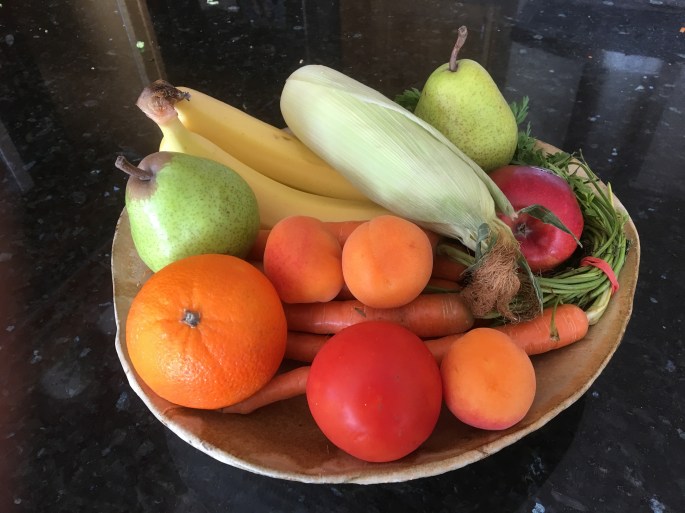
FOOD. Photo by Leonie Elizabeth. 03 February 2018.

What is Food?

Food is such an important part of all our daily lives that one would think there would be a universally accepted simple definition. When I went hunting for one, I found that there was no clear definition.

Medically defined, food is described as ‘a nourishing substance that is eaten or otherwise taken into the body to sustain life, provide energy, or promote growth’ (1). Legal definitions in food regulations on supply have a broader sweep effectively describing food as ‘anything that is intended or offered for human consumption’ (2) which can include animals and plants, prepared or partly prepared; ingredients; additives; anything used in its preparation; anything that comes in contact with that substance, such as processing aids; or chewing gum (3-5). Continue reading “ACHIVED: Food. What is it?”